
AI
How Much Does a Chatbot Cost? Types, Pricing and Uses for Business
What a chatbot costs to launch and to run, the three types of bots, what they do for a business, which channel to choose and when you do not need one.
 10 min read
Telegram bot pricing by type, what drives the quote, monthly running costs, payments and Stars, broadcast limits, Mini Apps and who owns the bot.

A Telegram bot for a business costs from $500 at Synapse Team for a scripted bot with buttons, delivered in 3–5 days. An AI bot that answers from your knowledge base starts at $2,000, and a Telegram Mini App at $2,500. Telegram itself charges nothing for a bot: you pay for development, hosting and, if the bot uses AI, the language model.
Below: prices by bot type, what drives the quote, what a bot costs to run, how payments and broadcasts work, what changed in Telegram during 2026 and who owns the bot after launch.
The price depends on the type of bot. A builder is enough for a simple menu and broadcasts. A custom scripted bot takes the customer through steps written for your process. An AI bot understands free text. A Mini App is a small application inside Telegram.
| Bot builder | Scripted bot | AI bot | Mini App | |
|---|---|---|---|---|
| What it does | Menu, FAQ, broadcasts | Bookings, orders, payments through your systems | Answers free text from your knowledge base, hands off to a person | Catalog, cart, account or calendar on a full screen |
| When it fits | A fixed set of questions and a small list | A clear process the customer follows step by step | Questions come in the customer’s own words | Buttons and messages are not enough, the task needs a full screen |
| Monthly costs | Subscription, grows with contacts | Hosting | Hosting and the AI model by usage | Hosting |
| Launch price | from $0 a month free plan, paid plans grow with contacts | from $500 3–5 days | from $2,000 1–3 weeks | from $2,500 2–3 weeks |
With a classic build, a scripted bot starts at $1,200 and takes 1–2 weeks. With AI the team writes code faster, and an engineer reviews every scenario before launch. We send a precise quote and timeline within one business day of a short brief.
A bot takes over the conversations and actions that repeat. The most common jobs:
For what a chatbot is and how a scripted bot differs from an AI chatbot, see our guide to chatbots for business.
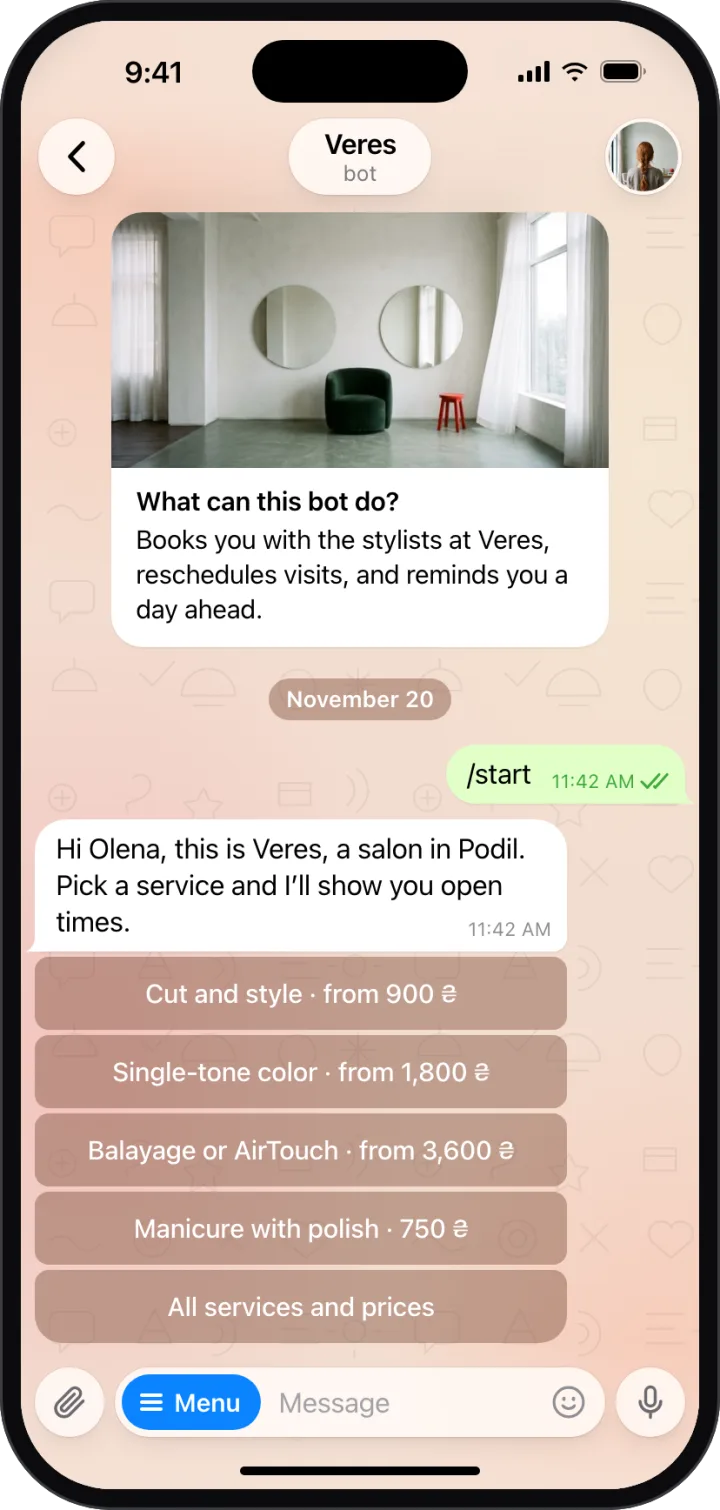
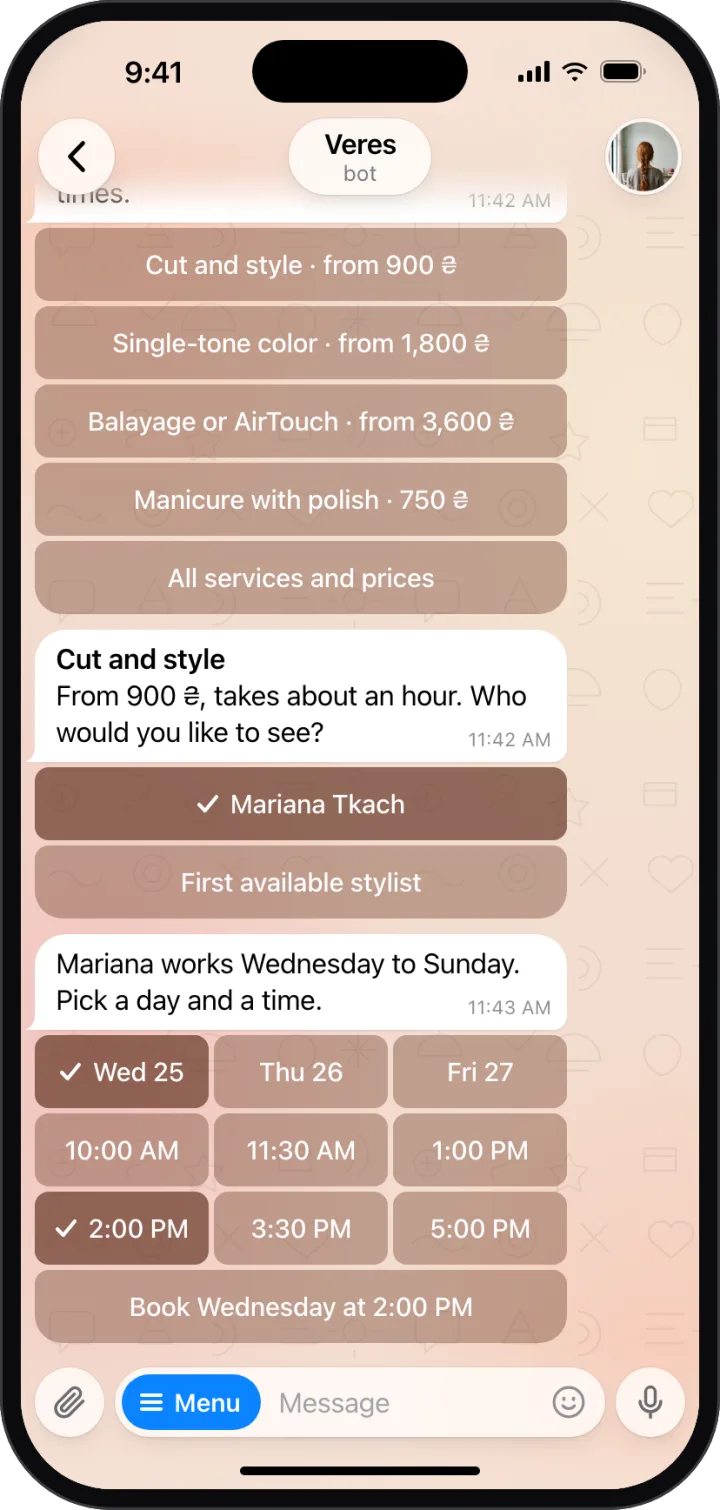
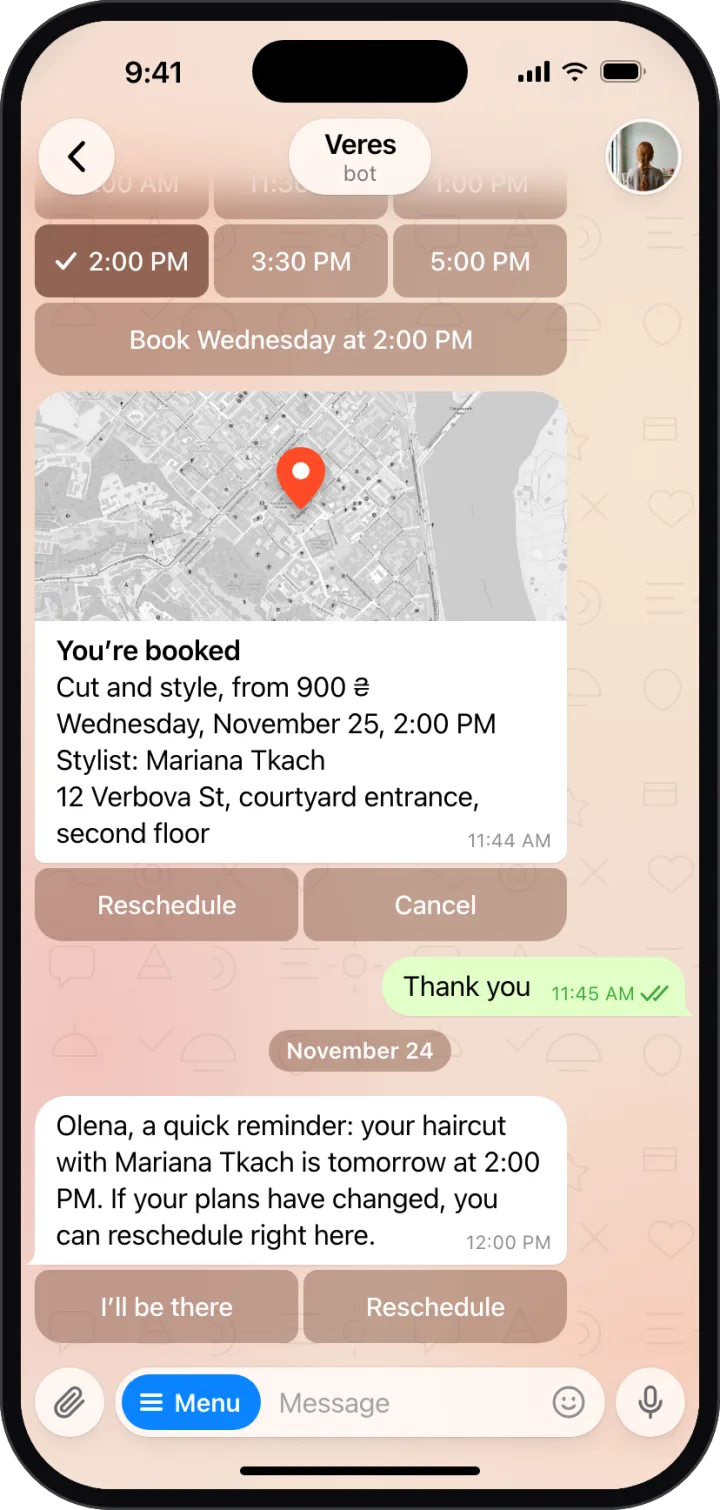
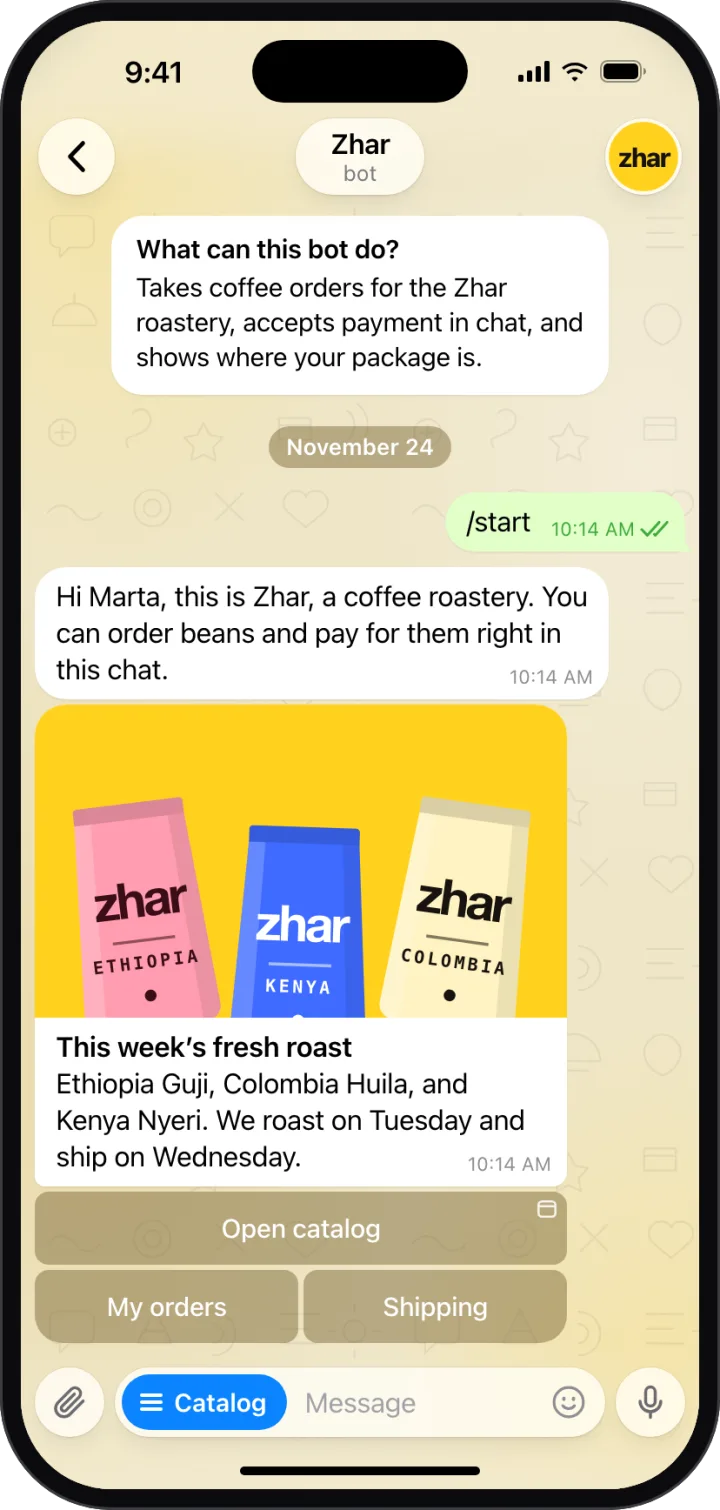
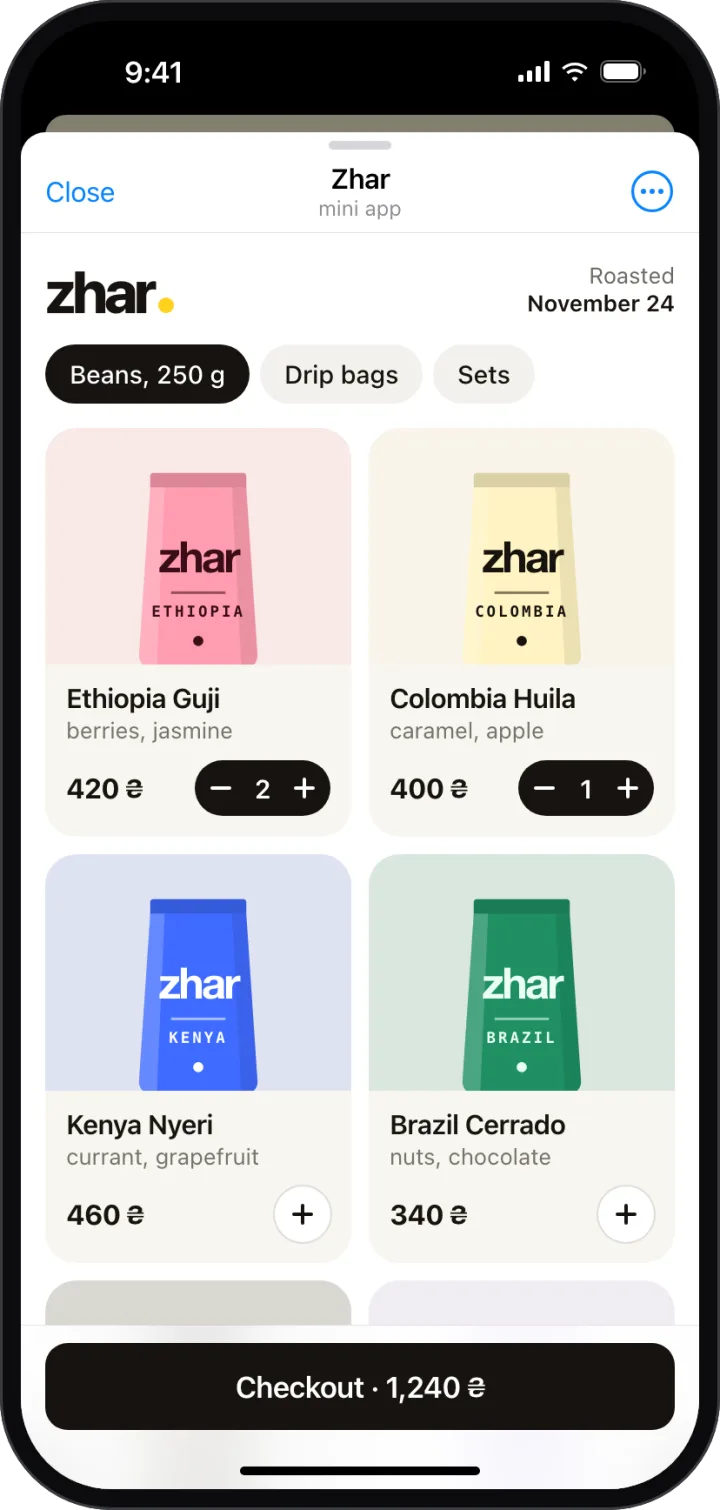
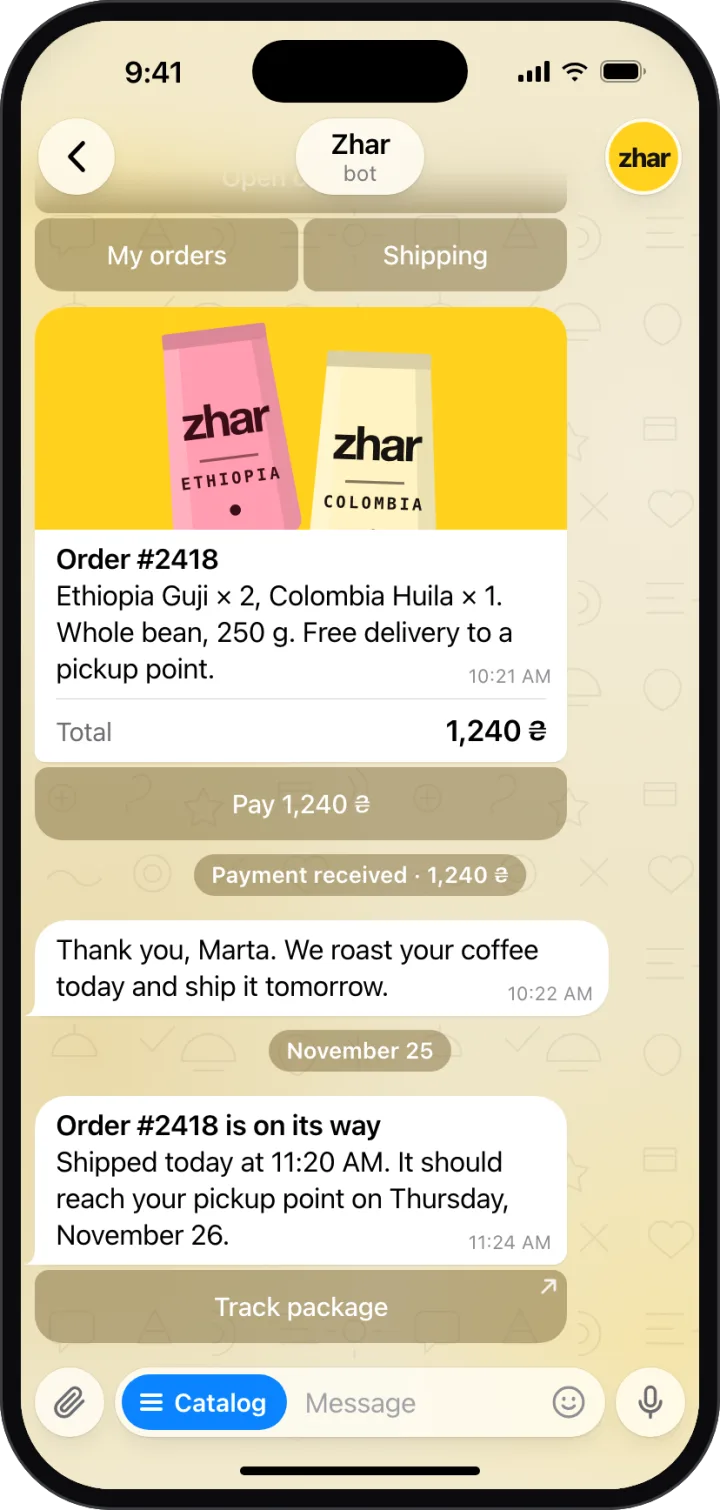
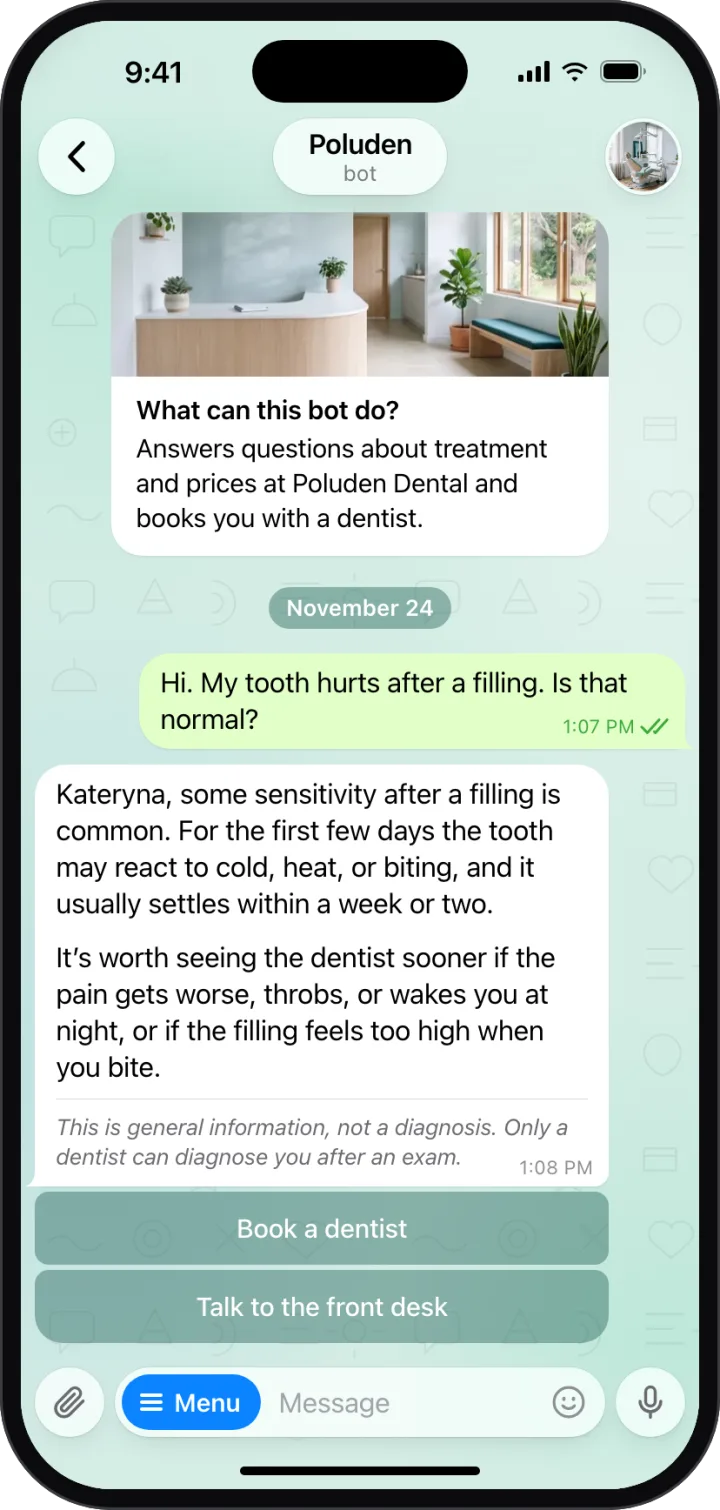
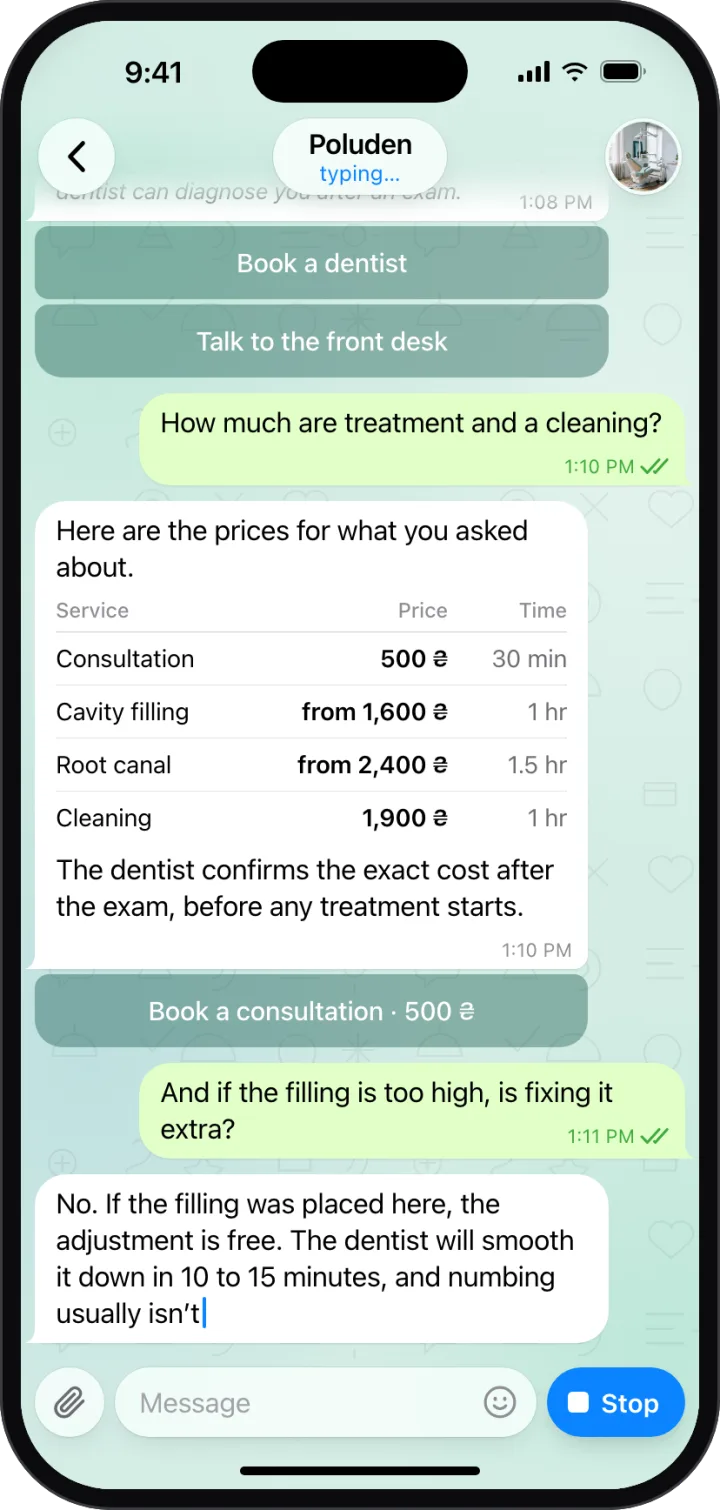
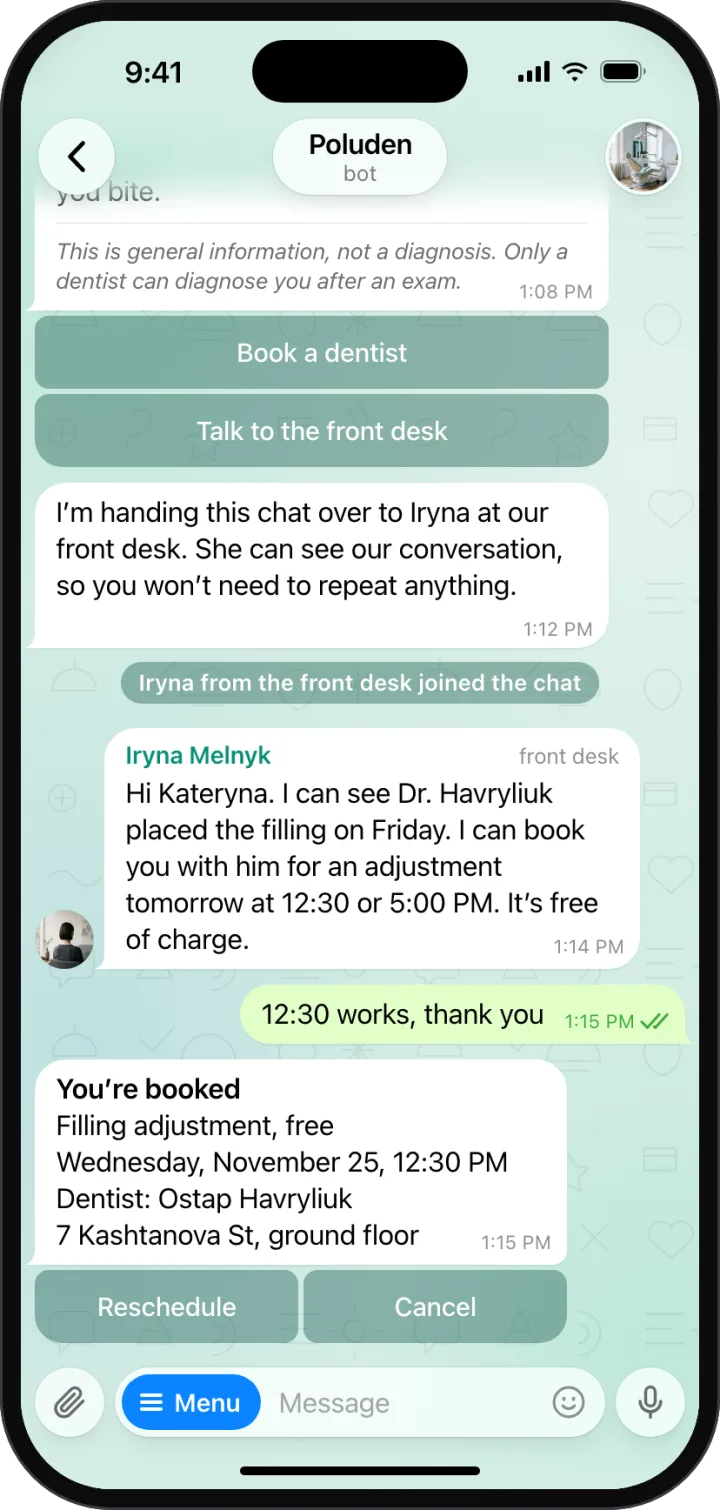
Four common jobs and what the bot looks like on the customer's phone.
The bot shows services with prices and the specialist's free slots, then confirms the booking. The day before the visit it sends a reminder with Reschedule and Cancel buttons.
The catalog opens as a Mini App with a product grid, a cart and a checkout button. The invoice and the order status arrive in the same chat.
The patient asks a question in their own words. The bot answers from the clinic's knowledge base, shows prices as a table and hands the conversation to a receptionist when a person is needed.
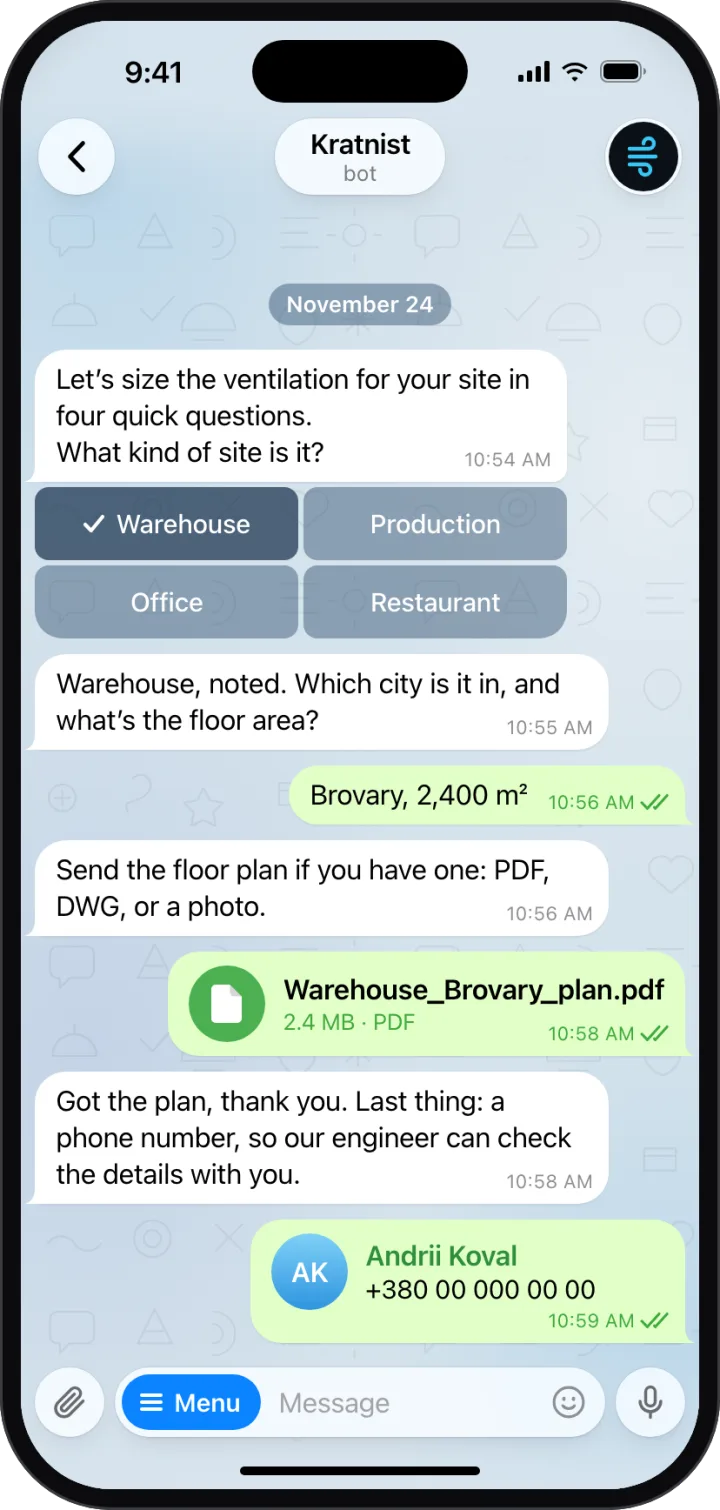
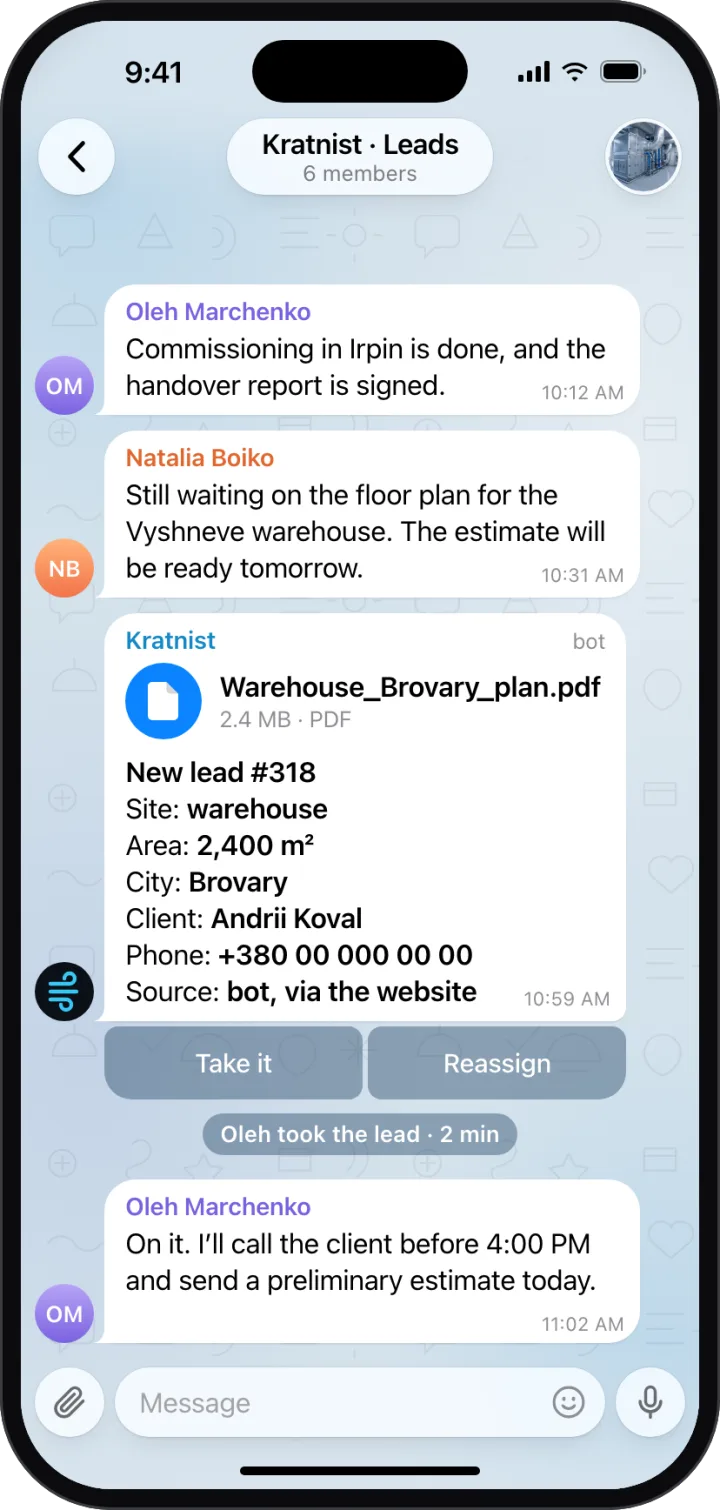
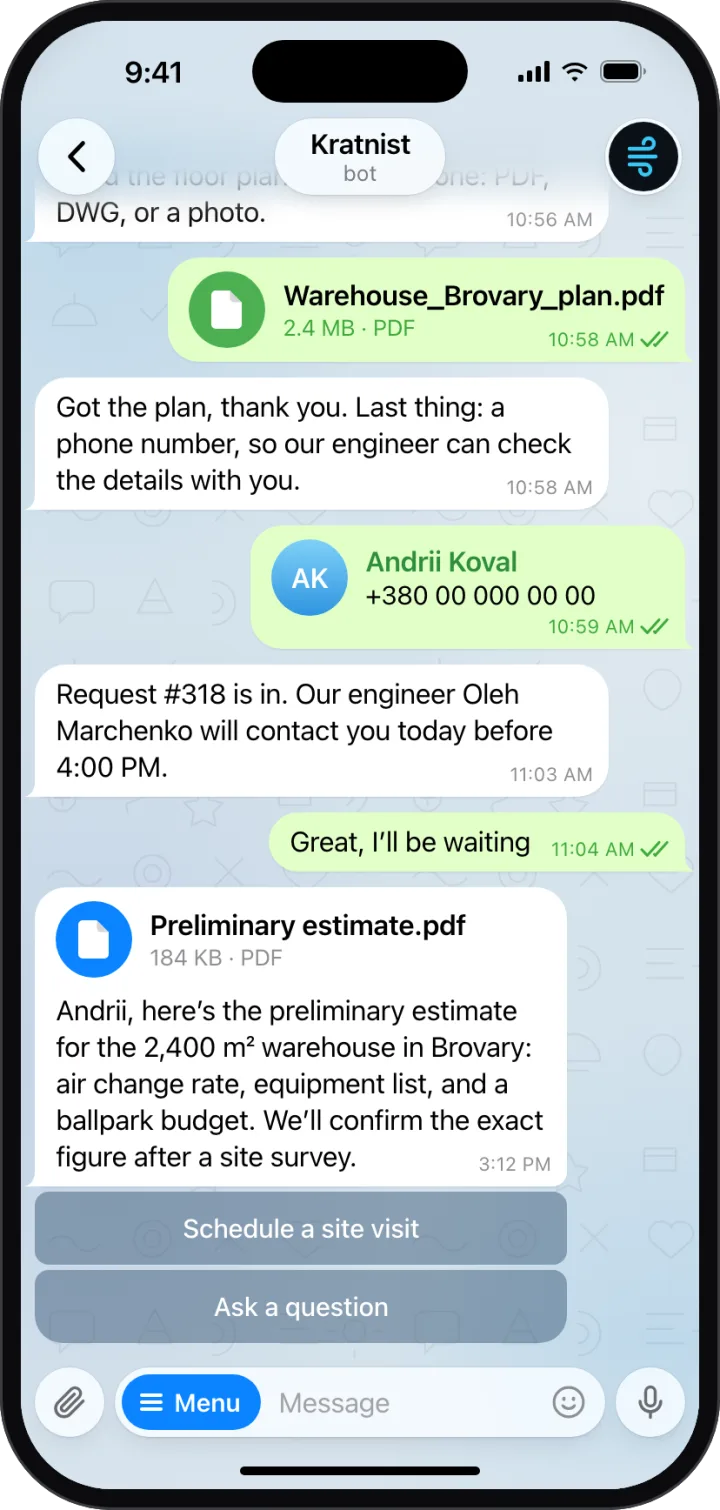
The bot collects the request step by step: site type, area, floor plan, phone number. The lead lands in the engineers' group chat, and the client receives a preliminary quote in the chat.
The quote depends on the amount of work. These factors move the price:
A builder is enough while the bot answers from a fixed menu and sends broadcasts. ManyChat, for example, has a free plan, and its paid plans grow with the contact list (pricing page, November 2026).
Custom development makes sense when the bot has to work with your data: schedule, inventory, CRM, payments. You pay once for the build, then for hosting, the AI model if the bot uses one, and support as agreed. The scenarios follow your process, the code and the database belong to you, and the number of subscribers does not change the price.
You can start small. The first version handles one job, such as booking. More scenarios follow once you see how customers use the bot.
Telegram charges no subscription. Its platform overview says the Bot Platform is free for both users and developers (November 2026). After launch, three costs remain:
The payment provider takes its own fee on every payment. That is not a cost of the bot, but it belongs in the product price.
Payment rules in Telegram depend on what you sell.
Goods and services. Payments go through a provider that you connect in the bot settings. Telegram takes no cut: the payments documentation says the platform is free and charges no commission (November 2026). Apple Pay and Google Pay are supported. Only the provider charges a fee. Stripe, which the documentation names, lists its own rates on its site. The seller must give customers purchase terms and a support contact, and handles disputes.
Digital goods and services. Access to a course, a content subscription or features inside the bot can be sold only for Telegram Stars, the messenger's in-app currency. Out of 100 Stars that cost the user $1.99, the developer receives $1.30, and the rest goes to Apple or Google and Telegram (table in the documentation, November 2026). Telegram may hold received Stars for up to 21 days before they can be withdrawn (bot developer terms).
If you sell a physical product or an offline service, you do not need Stars. If you sell a digital product, build that difference into the price.
Over the year Telegram added several features that make an AI bot easier to use. All of them are in the Bot API changelog, where the latest version, 10.4, is dated November 9, 2026.
If the bot must act across several systems and not only answer, that is a job for an AI agent.
A bot cannot message a person first: the user has to start the bot. So the bot builds its own subscriber list, and a list cannot be bought.
Limits from the official FAQ (November 2026):
That is enough for a list of a few thousand subscribers: a broadcast to 5,000 people takes about three minutes. Paid broadcasts at up to 1,000 messages per second are open only to bots with at least 100,000 monthly active users and 100,000 Stars on the balance. A small business will not need them.
Spam and unsolicited messages are forbidden by the platform terms. Violations can get both the bot and the owner's account banned.
A Mini App is a web application that opens full screen inside Telegram. The customer installs nothing and enters no password: Telegram tells the app who opened it.
A Mini App is the right tool when buttons and messages are no longer enough:
At Synapse Team a Mini App starts at $2,500 and takes 2–3 weeks. It is a separate build: the interface, the server side and the link to the bot. The two often work together: the bot sends notifications and invoices, and the Mini App shows the catalog.
A Telegram bot belongs to the account that created it. The bot developer terms say so: if that account is lost or banned, the bot and its Stars balance may be lost too.
That is why we register the bot on the client's account and, after launch, hand over:
Check these points in the development contract with any contractor. If the bot is registered on the agency's account and you never received the code, changing contractors means building from scratch and losing the subscriber list.
At Synapse Team a scripted bot is ready in 3–5 days, an AI bot in 1–3 weeks and a Mini App in 2–3 weeks. Add the time you need to approve the copy and test the bot.
For an accurate quote, prepare:
That is enough to describe the task in a brief and get a precise quote. How we build bots and assistants is covered on the AI chatbot development page.
At Synapse Team a scripted bot with buttons starts at $500 (3–5 days), an AI bot that answers from your knowledge base at $2,000 (1–3 weeks) and a Mini App at $2,500. The quote depends on the number of scenarios, integrations and payments.
The platform is free: Telegram charges nothing to create a bot or to send ordinary messages. A simple menu bot can be assembled in a builder on a free plan. You pay when you need custom scenarios, integrations or AI.
Telegram has no subscription fee. A custom bot needs hosting, an AI bot also pays the model provider by usage, and support is agreed per project. On an entry-level model a conversation costs less than one cent.
No, not for goods and services: only the payment provider charges a fee. Digital goods must be sold for Telegram Stars, and there the developer receives $1.30 out of every $1.99 the user pays.
A scripted bot takes 3–5 days, an AI bot 1–3 weeks and a Mini App 2–3 weeks at Synapse Team. Add the time you need to approve the copy and test the bot.
The Telegram account that created it. We register the bot on the client’s account and hand over the token, the source code, the database and server access.
A bot cannot start a conversation: the user has to launch it first. After that it can send broadcasts at about 30 messages per second. Spam is forbidden and can get the bot and the owner’s account banned.
When buttons and messages are no longer enough: a catalog with filters and a cart, a customer account, a booking calendar or a multi-step form. A Mini App opens full screen inside Telegram and usually works together with a bot.
Author
Roman Barbotkin
Founder & CEO
Roman founded Synapse Team and leads delivery for clients in the US, EU and Ukraine. He writes about how projects actually run: scope, budgets, timelines, and where AI genuinely helps.
What a chatbot costs to launch and to run, the three types of bots, what they do for a business, which channel to choose and when you do not need one.
10 min readWhat an AI agent does in a business, how it differs from a chatbot and automation, examples by department, four agents we built, costs and how to start.
9 min readReal 2026 prices for a Shopify store, a custom store and a store with hundreds of products, AI-powered and classic, plus platform choice, monthly running costs and timelines.
7 min readContact us
I run a business, but I get no clients or leads from the internet. What should I do?
Depends on the goal. Pick what sounds closest and I will suggest a solution with a ballpark estimate:
We reply within one business day. NDA signed before we start.
We use cookies
Necessary cookies keep the site working. Analytics cookies show us where clients come from, advertising cookies show which ads work. We turn them on only with your consent. Privacy policy