AI Agents for Business: What They Do, Examples and Costs
What an AI agent does in a business, how it differs from a chatbot and automation, examples by department, four agents we built, costs and how to start.
An AI agent for business is a language model with access to your tools and a job to finish: it reads emails or tickets, checks the CRM, updates records, writes replies and passes risky decisions to a person. A first agent for one process starts at $3,000 and takes 2–4 weeks with our team.
Below: how an agent differs from a chatbot and ordinary automation, AI agent examples by department, four agents our team has built, where agents are a bad fit, what they cost to build and run, and how a small business can start without a big budget.
What an AI agent does in a business
An AI agent is a language model connected to your systems and given a job. It has four parts:
A goal. Not a question to answer, but a result to reach: "answer every new lead within five minutes" or "keep ad spend inside the budget".
Tools. Access to the systems where the work happens: email, CRM, help desk, ad accounts, a database, a spreadsheet, an internal API.
Rules. What the agent may do on its own, what it must ask about, and when it stops and calls a person.
Memory. The context of the task: the customer's history, earlier steps, the documents it has already read.
With these parts, the agent works in a loop: it looks at the situation, decides on the next step, uses a tool, checks the result and repeats until the goal is reached or a rule tells it to stop. That loop is what separates an agent from a model that only writes text.
Agents also differ in how much freedom they get. Some only suggest actions and wait for a click. Others act within limits: they send standard replies, update records or pause a failing ad on their own and report afterwards. Most businesses start with the first kind and widen the limits once the agent has proven itself.
AI agent, chatbot or automation: which one you need
Not every task needs an agent. A chatbot answers questions, rule-based automation repeats the same steps, and an agent is worth it when each case is a little different and requires a decision.
AI chatbot
AI automation
AI agent
What it does
Answers questions in a chat
Repeats the same steps by rules
Reaches a goal: plans, acts, checks the result
Decisions
None, it only replies
None, fixed if-then logic
Yes, within the rules you set
Works in your systems
Reads the knowledge base
Moves data between apps
Reads and changes data in several systems
Typical task
Delivery terms, prices, opening hours
New order goes to CRM and accounting
Score a lead, reply and book a call
When a person steps in
Questions outside the knowledge base
When a step fails
Risky actions and exceptions
AI-powered start
from $2,000 1–3 weeks
from $2,000 1–3 weeks
from $3,000 2–4 weeks
RPA bots belong to the automation column: they click through screens by a fixed script and break when the screen changes.
A simple test: if you can draw the process as a flowchart with no "it depends" boxes, choose AI automation or plain integration: it is cheaper and more predictable. If clients mostly ask questions answered in your documents, an AI chatbot is enough. An agent pays off where a person today reads, compares, decides and then clicks through three systems.
AI agent examples by department
These are the use cases where agents already work in small and mid-sized companies. Each one combines reading unstructured input, making a decision and acting in a tool.
Sales and lead generation
The agent reads every new inquiry, checks it against your ideal client profile, enriches it with public data, scores it, writes a personal first reply and books a call in the calendar. Hot leads go to a manager immediately, the rest get a nurture sequence. The manager no longer starts the day by sorting an inbox.
InputA new inquiry from the form or email
AgentScores it against your ideal client profile
ActionWrites the first reply and books a call
PersonA hot lead goes straight to the manager
Customer support
The agent answers questions from your knowledge base, but unlike a chatbot it also acts: it checks the order status in your store, changes the delivery address, issues a refund within a set limit or creates a ticket with a summary for the team. Anything outside its rules goes to a person with the full context attached.
InputA question in chat or email
AgentFinds the answer and checks the order
ActionReplies, changes the address, issues a refund within the limit
PersonAnything outside the rules: a ticket with the full context
Marketing and ads
The agent watches campaigns every day: it finds wasted search terms, spots ads with falling results, suggests moving budget between regions and prepares a weekly report. In the safe setup it proposes changes and a marketer approves them with one click.
InputThe daily campaign check
AgentReads search terms and ad results
ActionPrepares budget changes and the weekly report
PersonThe marketer approves the changes with one click
Operations and IT
The agent processes incoming documents (invoices, contracts, applications), extracts the data into your systems and flags anything unusual. In IT it watches servers and services, reacts to load spikes and incidents and wakes up an engineer only when its own actions are not enough.
InputAn incoming document or a server alert
AgentExtracts the data and matches it with your records
ActionEnters the data, reacts to the load spike
PersonAn engineer or manager for anything unusual
Finance and back office
The agent matches payments with invoices, chases overdue clients with polite reminders, prepares data for the accountant and checks expenses against policy. Final approvals and anything involving money transfers stay with people.
InputA payment arrives or an invoice falls due
AgentMatches the payment with the invoice
ActionReminds the client, prepares data for the accountant
PersonApprovals and money transfers stay with people
Four AI agents we have built
Every example in this section is a system our team built. No client names, but the tasks and the safeguards are real.
Upwex: an agent that finds and bids on freelance jobs
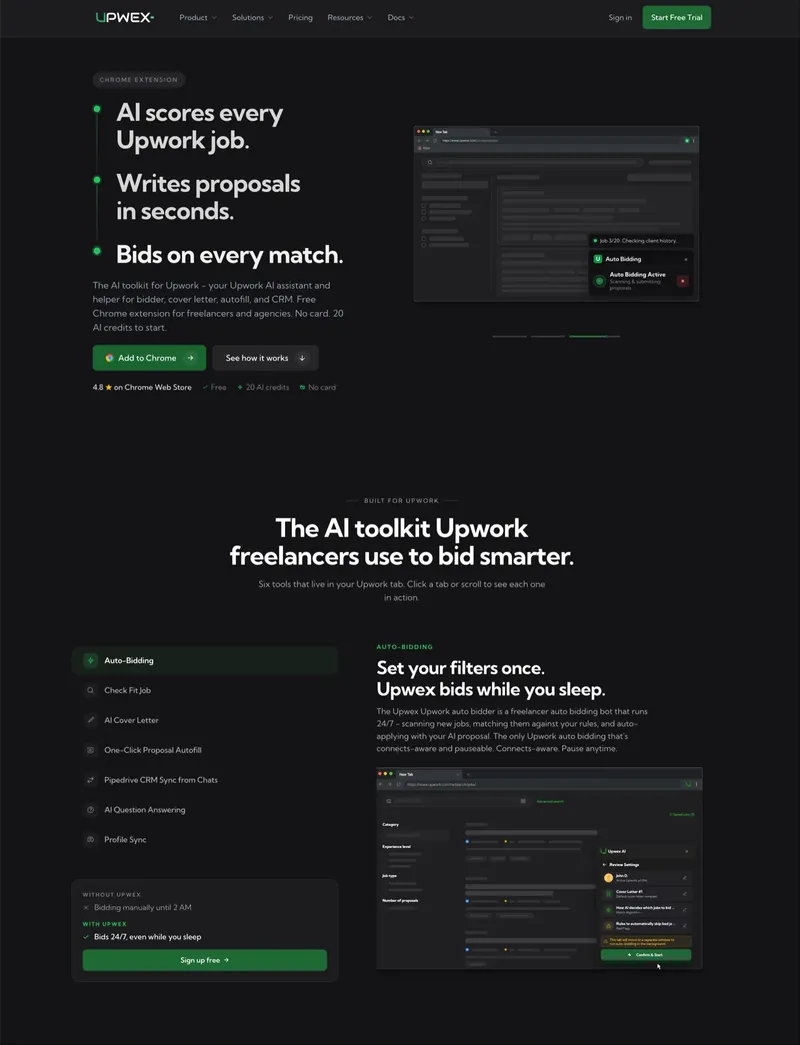
Upwex is our own product for freelancers and agencies on Upwork. Its agent reads the job feed, scores each job against the user's profile, writes a tailored proposal based on the profile, portfolio and past wins and submits it on its own, 24/7, within the rules the user sets: budget, niche, client rating, number of bids per day. The product went from brief to paying users in 12 weeks and has 5,000+ users. Building it taught us what an autonomous agent needs in production: hard limits, logs of every action and a way for the owner to switch it off instantly.
An agent that turns inbound requests into ready briefs
For a service business we built an AI agent that talks to every new inquiry. It finds out what the client needs, asks the follow-up questions a manager would ask, checks that the request makes sense and hands the team a structured brief instead of a vague message. The team spends its time on the quote, not on a round of clarifying emails.
An ads agent that proposes, people approve
In several projects we connected an AI agent to Google Ads and Reddit Ads through their official APIs (Google reviews and approves API access). The agent manages bids, negative keywords, regions and audience segments. It does not change anything on its own: it prepares proposals such as "add these negative keywords" or "move budget between regions", and a marketer approves or rejects each one.
An agent that protects a server under load
For a high-traffic project we built an agent that watches the load in real time. When a spike hits, it decides what is happening: real visitors, a crawler or an attack. Then it reroutes traffic to spare capacity or throttles and blocks abusive sources, so the site stays up for real users. Engineers get a report of what happened and what the agent did.
Where an AI agent is a bad fit
An agent is not the answer to every task. It is better to wait or choose something simpler when:
A mistake is expensive and nobody checks. Payments, legal commitments and medical decisions need a person to approve, or the agent should only prepare a draft.
The data is a mess. If prices live in three spreadsheets that contradict each other, the agent will confidently use the wrong one. Fix the source first.
The task is rare. A process that happens twice a month will not repay the build. Automate what happens dozens of times a day.
The process is not defined. If the team cannot explain how a good result looks, the agent cannot learn it either. Write the rules down before you automate them.
A simpler tool does the job. Fixed steps without decisions are cheaper and more reliable with rule-based automation.
OpenAI gives the same advice in its practical guide to building agents (2025): start with workflows where rules break down and judgment is needed, and keep a human in control of high-risk actions.
What an AI agent costs to build and run
The price depends on how many systems the agent works with and how much it is allowed to do on its own. Our starting prices for AI work:
A first agent for one process is priced like an AI feature: from $3,000 and 2–4 weeks with AI-powered development. When the agent is the core of a new product, the start is $6,000. See AI agent development for what is included, and the pricing page for all our prices in one place.
After launch you pay for three things:
Model usage. The AI provider charges per volume of text the agent processes. For most small business tasks this is a modest monthly bill that grows with the number of cases, and we estimate it before the build.
Hosting and monitoring. The agent runs on a server and writes logs, so you can see every action.
Support. Prompts, rules and integrations need updates as your processes and the AI models change.
How to start with AI agents in a small business
Pick one process. Choose a repetitive task that eats hours every week and has a clear result, such as answering inquiries or sorting documents.
Describe the rules. Write down what a good result looks like, what the agent may do alone and when it must call a person.
Start in suggestion mode. For the first weeks the agent prepares actions and a person approves them. This shows where it is right and where the rules need work.
Give it more freedom gradually. Once the agent is right consistently, let it act on its own within limits and keep the logs.
Measure and expand. Track hours saved, response time and errors, then move to the next process.
AI speeds up development, and our engineers guarantee the quality: architecture, data security and the agent's limits are designed by people. Describe your process in the brief chat, and the team sends an exact quote within one business day.
Frequently asked questions
Are AI agents worth it for a small business?
Yes, when one repetitive process eats hours every week: answering inquiries, sorting documents, watching ad campaigns. Start with one process and measure the hours saved before you add the next one.
How long until an AI agent pays off?
Compare the build price with the hours it saves: hours per week the process takes today, times the hourly cost of the people doing it, minus model and hosting costs. A process that runs dozens of times a day pays off much faster than a rare one. A pilot in suggestion mode gives you real numbers before you widen the agent's limits.
Is our data safe with an AI agent?
It depends on how the agent is built. We give it access only to the systems it needs, log every action, use business accounts of AI providers that do not train on your data, and can host the agent on your own server.
Do we need developers, or is a no-code tool enough?
A no-code builder is enough for a simple agent inside popular apps. Developers are needed when the agent works with your own database or API, has to follow strict rules or handles customer data.
Can an AI agent replace an employee?
Usually it takes over part of a role: the repetitive reading, sorting and replying, while the employee keeps decisions, exceptions and client relationships. Sometimes it covers a whole narrow role: in Upwex, auto-bidding does the work agencies used to hire a separate lead-gen manager for.
How do we know the agent is doing a good job?
Decide on the metrics before launch: response time, hours saved, share of cases handled without a person, number of errors. The agent logs every action, so you can check any case and see why it acted the way it did.
Roman founded Synapse Team and leads delivery for clients in the US, EU and Ukraine. He writes about how projects actually run: scope, budgets, timelines, and where AI genuinely helps.
Ecommerce Website Cost in 2026: Real Prices by Store Type
Real 2026 prices for a Shopify store, a custom store and a store with hundreds of products, AI-powered and classic, plus platform choice, monthly running costs and timelines.
How Long Does It Take to Build a Website? Timeline by Stage
Real 2026 timelines for a landing page, a corporate website and an online store, AI-powered and classic, plus every stage of the build: what we do, what we need from you and how long it takes.
How Much Does a Website Cost in 2026? Prices and What Is Included
Real 2026 prices for a landing page, a corporate website and an online store, each in two options, AI-powered and classic, with timelines. Plus monthly running costs and what a quote should include.
We reply within one business day. NDA signed before we start.
We use cookies
Necessary cookies keep the site working. Analytics cookies show us where clients come from, advertising cookies show which ads work. We turn them on only with your consent. Privacy policy





 7 min read